


Introduction
Space exploration stands as a testament to human curiosity and technological prowess. Among the prominent figures in this field is Sunita Williams, an astronaut whose career has been marked by groundbreaking achievements and a commitment to advancing space technology. This blog explores the technological innovations that have supported her missions, highlighting her recent accomplishments and the impact of her work on the future of space exploration.
Sunita Williams’ Background
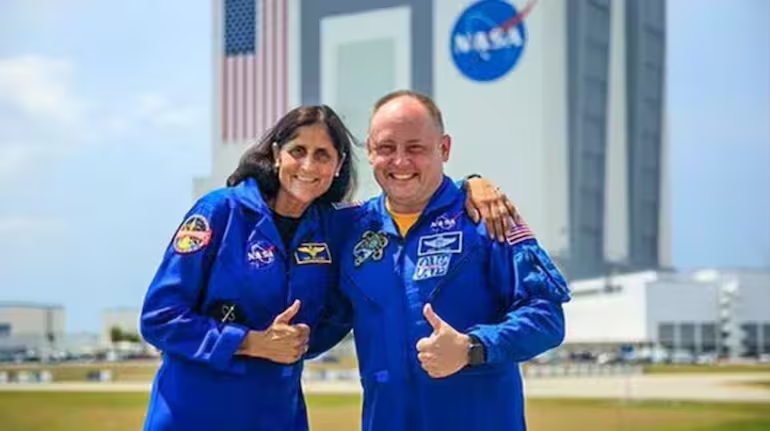
Born on September 19, 1965, in Euclid, Ohio, Sunita Williams is an American astronaut and a retired U.S. Navy Captain. Her journey to becoming an astronaut began at the U.S. Naval Academy, where she earned a Bachelor of Science in Physical Science in 1987. She later obtained a Master of Science in Engineering Management from the Florida Institute of Technology in 1995.Before joining NASA, Williams served as a helicopter pilot and a test pilot in the U.S. Navy, logging over 2,770 flight hours and flying more than 30 different aircraft. Her diverse background in aviation and engineering laid the foundation for her future achievements in space.
Key Technological Innovations

Robotics Training
A cornerstone of astronaut Sunita Williams’ missions has been her extensive training in robotics. During her preparation for spaceflight, she worked closely with the Russian Federal Space Agency, gaining expertise in operating the International Space Station’s (ISS) robotic systems. This training was crucial for her role in conducting repairs and performing experiments aboard the ISS using advanced robotic technologies.

Spacewalk Equipment
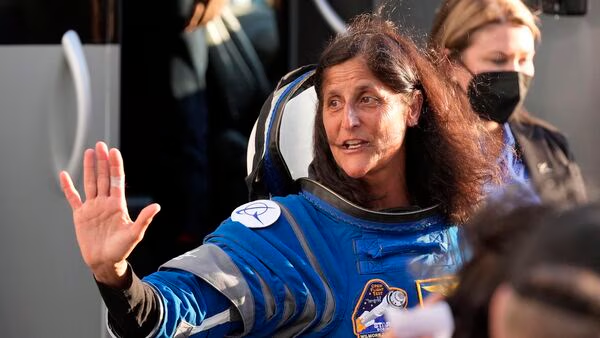
Williams is renowned for her record-setting spacewalks, having completed seven during her missions, totaling 50 hours and 40 minutes outside the ISS. These spacewalks required sophisticated technology, including specialized suits designed for extravehicular activities. Williams’ ability to conduct complex repairs and upgrades during these spacewalks showcased the effectiveness of the technology available to astronauts.

Commercial Crew Program
In 2015, Sunita Williams was selected as one of the first astronauts for NASA’s Commercial Crew Program, which aims to develop private spacecraft for transporting astronauts to the ISS. Recently, she served as the pilot for Boeing’s Starliner on its inaugural crewed test flight in 2024. This mission marked a significant milestone in her career, as she became the first woman and Asian American to pilot a spacecraft test flight.The Starliner mission is crucial for certifying the spacecraft for regular crewed flights to the ISS. Williams and her crewmate, Commander Barry “Butch” Wilmore, conducted tests and validated the Starliner’s systems during their time aboard the ISS, further demonstrating the importance of technological advancements in space exploration.
Health and Safety Innovations
Research on Astronaut Health
During her missions, astronaut Sunita Williams has participated in research related to astronaut health, including studies on microbial life aboard the ISS. This research is vital for understanding how long-duration space missions affect human health and safety. The findings can also have significant implications for health on Earth, as researchers study the behavior of microbes in microgravity.
Physical Fitness Technology

Maintaining physical fitness is crucial for astronauts during long missions, and Williams famously completed a triathlon in space using specialized equipment. This equipment, including treadmills and stationary bicycles, is designed to counteract the effects of microgravity on the human body. Williams’ ability to stay physically active while in orbit highlights the importance of technology in supporting astronaut health.
Recent Updates on Sunita Williams
As of August 2024, astronaut Sunita Williams is currently aboard the ISS following her successful launch on June 5, 2024, aboard Boeing’s Starliner. The mission, known as the Boeing Crew Flight Test (CFT), is a significant step in expanding commercial partnerships in space exploration. While on the ISS, Williams and Wilmore conducted experiments and validated the Starliner’s systems, contributing to the ongoing research and operations aboard the space station.The Starliner mission faced challenges, including thruster failures and helium leaks in its propulsion system. However, NASA has conducted extensive simulations and assessments to ensure the safety of the spacecraft and its crew. Williams’ experience and expertise have been instrumental in navigating these challenges, further solidifying her reputation as a leading figure in space exploration.
The Future of Space Technology

Implications of Williams’ Work
The contributions of Sunita Williams to space exploration extend beyond her individual achievements. Her work with the Commercial Crew Program and her participation in groundbreaking missions are paving the way for future advancements in space travel. As commercial partnerships become increasingly important in the space industry, Williams’ legacy will inspire the next generation of astronauts and engineers.
Emerging Technologies
Looking ahead, emerging technologies such as artificial intelligence, advanced propulsion systems, and sustainable life-support systems are set to revolutionize space exploration. Williams’ experiences and insights will undoubtedly play a crucial role in shaping the development and implementation of these technologies, ensuring that future missions are safer and more efficient.

Conclusion
Sunita Williams exemplifies the spirit of exploration and innovation that defines space travel. Her remarkable achievements, supported by cutting-edge technology, continue to inspire future generations to pursue careers in science, technology, engineering, and mathematics (STEM). As we look to the future, the lessons learned from her missions will be integral in advancing our understanding of space and expanding humanity’s reach beyond Earth. Williams’ journey from Earth to orbit serves as a powerful reminder of the potential of human ingenuity and the importance of technological advancements in pushing the boundaries of what is possible. Her story encourages us to embrace innovation and explore the unknown, ensuring that the legacy of space exploration continues to thrive.
https://www.nasa.gov/humans-in-space/astronauts/sunita-williams